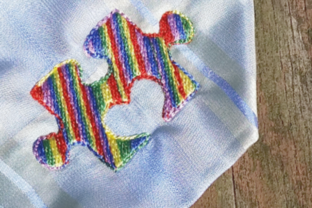
Mini Heart Puzzle Piece: A Designer’s Review
As an embroidery designer who spends more time staring at stitch maps than I do sleeping, I have learned that the smallest designs often carry the heaviest weight. When I first loaded the Mini Heart Puzzle Piece into my digitizing software, I wasn’t looking for a showstopper. I was looking for utility. In the world of Awareness themed Embroidery, subtlety is often more powerful than volume. This design promises to be a quiet supporter, a small nod to neurodiversity or autism awareness that fits seamlessly into modern, minimalist aesthetics. But does it hold up under the needle? Let’s break down how this machine embroidery design performs in real-world applications.
First Impressions and Visual Personality
The immediate appeal of the Mini Heart Puzzle Piece lies in its compact geometry. It is not cluttered. Many awareness symbols suffer from over-digitization, where every tiny notch of a puzzle piece is rendered with such density that the fabric puckers before you even start stitching. This design, however, feels breathable. The shape creates a soft, approachable mood. It balances the iconic puzzle motif with the universal language of love, making it suitable for a broader audience than clinical or strictly medical-themed graphics.
I noticed immediately that the layout is optimized for small-scale reproduction. For Etsy sellers and small shop product creators, this is crucial. You are not just buying an image; you are buying a digital embroidery file that needs to look crisp on a onesie sleeve or a pocket square. The visual personality here is gentle and supportive, avoiding the harsh lines that can sometimes make puzzle motifs feel rigid or cold.
Real-World Application: The Tote Bag Test
To truly evaluate a design, you have to put it to work. I decided to test the Mini Heart Puzzle Piece on a canvas tote bag, a staple item for any craft business. Canvas is unforgiving; it shows every gap in coverage and every misaligned stitch. I used a standard cut-away stabilizer to ensure the fabric didn’t shift during the high-speed stitching.
The result was surprisingly clean. Because the design is "mini," it didn’t overwhelm the texture of the canvas. It sat neatly on the corner of the bag, acting as a subtle badge of solidarity rather than a loud statement. This is where the design shines for custom apparel and accessories. It works beautifully as a tote bag design accent, but I could easily see it thriving on a denim jacket pocket or the cuff of a sweatshirt embroidery project. For handmade product lines that rely on understated elegance, this asset is a winner.
It is important to note a detail from the product preview: the rainbow stitching seen in some promotional images is not part of the actual embroidery file. That effect is achieved by using variegated or rainbow thread. This is actually a benefit for the embroidery project manager. It means you have total control over the colorway. You can stick to traditional awareness colors, match a brand palette, or go monochrome for a sophisticated look. The design itself is a solid foundation, ready for your creative interpretation.
Navigating Fabric and Hoop Constraints
While the design is versatile, it is not without its technical demands. As a reviewer, I must advise caution when working with difficult substrates. If you are planning to use this on stretchy fabrics like jersey knits for baby embroidery items, your choice of stabilizer is non-negotiable. A lightweight tear-away might not provide enough support for the intricate edges of the puzzle shape, leading to distortion.
Furthermore, consider your hoop size. Just because the design is mini doesn’t mean you can ignore placement. On curved surfaces, such as the front panel of a cap, tension changes everything. I recommend running a test stitch on a scrap piece of the exact same fabric before committing to your final finished product. Check the stitch density in your machine’s preview mode. If your machine tends to bunch threads in tight corners, you may need to adjust your tension slightly.
For those interested in embroidered patch creation, this design is an excellent candidate. The closed shapes allow for clean merrowed edges or satin stitch borders if you choose to add them. However, always verify the specific file formats provided in the download package to ensure compatibility with your specific machine brand. Whether you use Brother, Janome, or Bernina, having the correct format prevents costly conversion errors.
Commercial Value and Brand Consistency
For commercial embroidery professionals and digital product sellers, consistency is key. The Mini Heart Puzzle Piece offers a reliable aesthetic that can anchor a collection. Imagine a line of holiday embroidery gifts for February or Autism Awareness Month in April. This design can be scaled and repeated across various items—pillow covers, tea towels, and aprons—without losing its integrity.
Customer trust is built on quality. A sloppy, pixelated, or poorly digitized design reflects poorly on your brand. This design, with its clean lines and thoughtful spacing, enhances perceived value. It signals to the buyer that care went into the creation process. When used in personalized gift contexts, such as adding a name alongside the symbol, the simplicity of the heart puzzle allows the text to breathe. It doesn’t compete for attention; it complements.
Practical Designer Notes for Best Results
- Test on Scrap Fabric: Always run a sample on the same material type you intend to use for the final sale. Fabric texture affects how the fill stitch and satin stitch elements lay down.
- Check Thread Contrast: Since the rainbow effect is thread-dependent, experiment with high-contrast threads on dark fabrics and tonal threads on light fabrics to see which reads better.
- Review Stitch Density: If you are stitching on thin fabric, ensure the density isn’t too high, which can cause perforation or stiffness.
- Confirm Licensing: Before selling design assets or finished items, double-check the license terms included with your purchase. Most designers allow commercial use for physical goods, but digital resale is rarely permitted.
- Mockup Testing: Use printable mockup tools to visualize the design on different products before stitching. This saves time and materials during the prototyping phase.
Final Verdict
The Mini Heart Puzzle Piece is a thoughtful addition to any awareness-focused library. It respects the intelligence of the viewer by avoiding unnecessary complexity while maintaining symbolic clarity. For the maker, it offers flexibility. For the buyer, it offers meaning. Whether you are creating a custom apparel line for a local nonprofit or crafting a personalized gift for a friend, this design delivers professional results with minimal fuss. Just remember: the magic is in the execution. Choose your threads wisely, stabilize correctly, and let this small symbol do its big work.